Why Website Performance Decides Your SEO, AEO, GEO, SEM and SMM Results
Short answer: every marketing channel ends on a web page. Search, ads, social posts, AI answers and WhatsApp broadcasts all send people to your site, so its speed works like a multiplier on all of them. A fast landing page gets more out of every visitor you earn or pay for. A slow one loses them before they see your offer.
Key takeaways
- Google uses Core Web Vitals in ranking. Aim for Largest Contentful Paint under 2.5 seconds on mobile.
- Most AI crawlers don’t run JavaScript. Pages that deliver their content in the first HTML response are easier for ChatGPT, Claude and Perplexity to read and cite.
- Landing page experience is part of Google Ads Quality Score, and every visitor who leaves early is a paid click wasted.
- In Deloitte’s study, a 0.1-second faster mobile site lifted retail conversions by 8.4%.
- You can test any page for free on Google PageSpeed Insights in two minutes.
One page, every channel
Most businesses plan marketing channel by channel: an SEO budget, an ads budget, a social media calendar. But the customer’s journey always meets in one place. Whether they searched on Google, tapped an Instagram ad or followed a link in a ChatGPT answer, the next thing they see is your landing page.
That’s why performance isn’t a technical extra. If the page takes four seconds to show anything on a phone, it doesn’t matter how good the ad or the ranking was. The visitor is already gone.
SEO: speed is part of how Google ranks pages
Google says its core ranking systems look at page experience, and Core Web Vitals are a big part of it. They measure three things: how fast the main content appears, how quickly the page reacts when you tap, and whether things jump around while it loads.
| Metric | What it measures | Good | Poor |
|---|---|---|---|
| Largest Contentful Paint (LCP) | Loading | 2.5 s or less | over 4 s |
| Interaction to Next Paint (INP) | Responsiveness | 200 ms or less | over 500 ms |
| Cumulative Layout Shift (CLS) | Visual stability | 0.1 or less | over 0.25 |
To be honest about it: speed won’t push a weak page to the top. Helpful, relevant content still matters most. But when several pages answer the question equally well, the faster one has the edge. And speed helps in two quieter ways. A server that responds quickly lets Googlebot crawl more of your pages, and visitors who don’t bounce straight back to the results are visitors who read, scroll and enquire.
AEO: answers need pages that are quick to read
Answer engine optimisation (AEO) is about being the answer: the featured snippet, the AI Overview source, the reply a voice assistant reads out. These systems pick passages that are easy to find and easy to trust. Clean HTML, a clear heading for each question, a short direct answer under it and FAQ schema all help. So does a page that loads quickly when the system, or the person who clicks through, comes to check it.
GEO: most AI crawlers read your raw HTML
Generative engine optimisation (GEO) is about getting your business mentioned and linked in tools like ChatGPT, Claude, Perplexity and Gemini. Here performance has a very practical side. Vercel studied how AI crawlers behave and found that the crawlers from OpenAI (ChatGPT), Anthropic (Claude) and Perplexity don’t run JavaScript. They read the HTML your server sends, and that’s it.
Many modern sites, including plenty built with website builders and React, send an almost empty page and fill it in with JavaScript. Visitors don’t notice, but an AI crawler sees a blank page. The fix is the same work that makes a site fast: server-side or static rendering, so the full text, headings and structured data arrive in the first response. Files such as llms.txt and agent skill files then tell AI tools what your business does in plain language.
SEM: you pay for every click, even the ones that leave
With Google Ads you pay when someone clicks, not when they enquire. If the landing page takes too long, people hit back and you still pay. Google also scores landing page experience as one of the three parts of Quality Score, next to expected click-through rate and ad relevance. Google says higher-quality ads typically cost less per click and win better positions.
So a faster landing page can help twice: a better Quality Score on the way in, and more enquiries from the clicks you buy. Both bring your cost per lead down. If you’re planning a campaign, our guide to Google Ads costs in Singapore explains the budget side.
SMM: social traffic is mobile, impatient and in-app
Social media marketing sends people from Facebook, Instagram, TikTok and LinkedIn, and most of those clicks happen on a phone. They usually open inside the app’s own browser, often on mobile data, while the person is in the middle of scrolling. Patience is short. A heavy hero video or a page full of large images can lose that visitor before the first word shows.
The same goes for WhatsApp and email campaigns. A broadcast sends a burst of people to one page in a few minutes. A light, well-cached page handles the rush. A slow one gets slower exactly when it matters.
Speed and conversions: the numbers
Two well-known studies put numbers on it:
- Deloitte, “Milliseconds Make Millions”: across 37 brands, a 0.1-second improvement in mobile site speed raised retail conversions by 8.4% and average order value by 9.2%. Travel conversions rose by 10.1%.
- Google and SOASTA research: as page load time goes from one second to three, the probability of a bounce rises by 32%. From one second to five, it rises by 90%.
Your own numbers will differ, but the direction is always the same. Faster pages keep more people, and people who stay are the ones who buy.
What we saw on our own projects
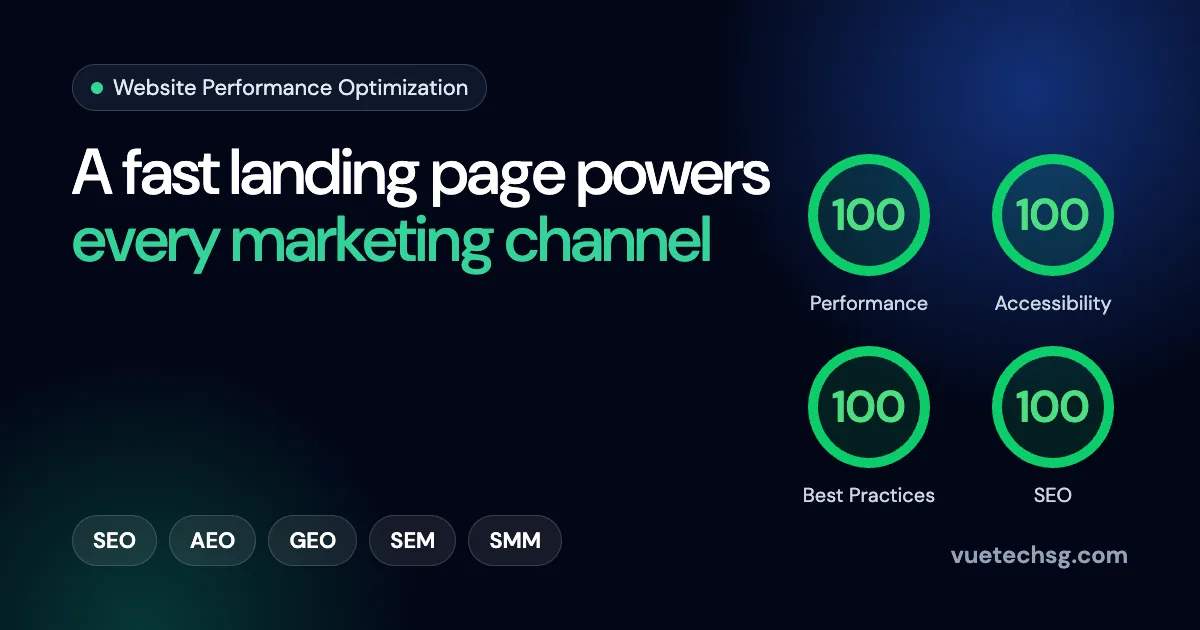
We recently optimised our own website and several client sites, and tested them on Google PageSpeed Insights on the mobile setting (Lighthouse 13.6, 13 November 2026):
| Website | Performance | Largest Contentful Paint |
|---|---|---|
| vuetechsg.com | 71 → 100 | 3.0 s → 1.1 s |
| 123ledlighting.sg(opens in a new tab) | 50 → 97 | 60.2 s → 2.0 s |
| 1pospay.com(opens in a new tab) | 100 | 1.1 s |
| global-businesses.com(opens in a new tab) | 100 | 0.9 s |
| 1cloudaicrm.com(opens in a new tab) | 96 | 1.1 s |
On 123ledlighting.sg the biggest win came from the images: the home page, menu and footer images went from 18.8 MB to 1.6 MB after we re-encoded them at the size they are actually shown. The home page JavaScript dropped from 509 KB to 109 KB. You can see every result, with links to re-run the tests, on our website performance optimization page.
How to check your own website in two minutes
- Open PageSpeed Insights and enter the page your ads or posts link to, not just your home page.
- Stay on the Mobile tab. It is stricter, and it is what most of your visitors use.
- Look at the four scores, then at Largest Contentful Paint and Total Blocking Time.
- If Google shows a “Discover what your real users are experiencing” section, check whether Core Web Vitals pass. That is real-visitor data.
- Run it twice. Lab scores move a few points between runs.
The most common reasons a site is slow
- Huge images: photos straight from a camera, shown at a fraction of their size.
- An autoplay hero video that has to load before anything else.
- Too much JavaScript: page builders, sliders, and libraries loaded on every page but used on one.
- Tag managers, chat widgets and pixels that all load immediately.
- Web fonts that block the text from showing.
- Pages that are built in the browser instead of on the server, so nothing shows until the scripts finish.
None of these need a redesign. In most cases, your site can look exactly the same and load several times faster.
FAQ
Is website speed a Google ranking factor?
Yes. Google's ranking systems use Core Web Vitals as part of page experience. Content relevance still matters more, but speed helps when pages are close and keeps visitors from bouncing back to the results.
How fast should a landing page load?
Aim for the main content to appear within 2.5 seconds on a phone, which is Google's good threshold for Largest Contentful Paint. The best landing pages show it in about one second.
Does page speed affect Google Ads?
Yes. Landing page experience is one of the three parts of Quality Score, and a slow page loses visitors you have already paid for, which raises your cost per lead.
Why does speed matter for AI search like ChatGPT?
Many AI crawlers read your raw HTML and don't run JavaScript. Fast, server-rendered pages with clear headings and structured data are easier for them to read, quote and recommend.
What is a good PageSpeed Insights score?
90 to 100 is good, 50 to 89 needs improvement, and below 50 is poor. Test on the mobile setting, because that is what most of your visitors use.
Want us to check your site?
Send us the page your marketing points to. We’ll run the tests, tell you what is slowing it down, and what it would take to reach 100, free of charge.
Sources
- Google Search Central: Understanding page experience
- web.dev: Web Vitals
- Google Search Central: Crawl budget management
- Google Ads Help: About Quality Score
- Google Ads Help: About ad quality
- Deloitte: Milliseconds Make Millions
- Think with Google: Page load time statistics
- Vercel: The rise of the AI crawler