Singapore SME Digital Trends in 2026: AI, Automation and Omnichannel Growth
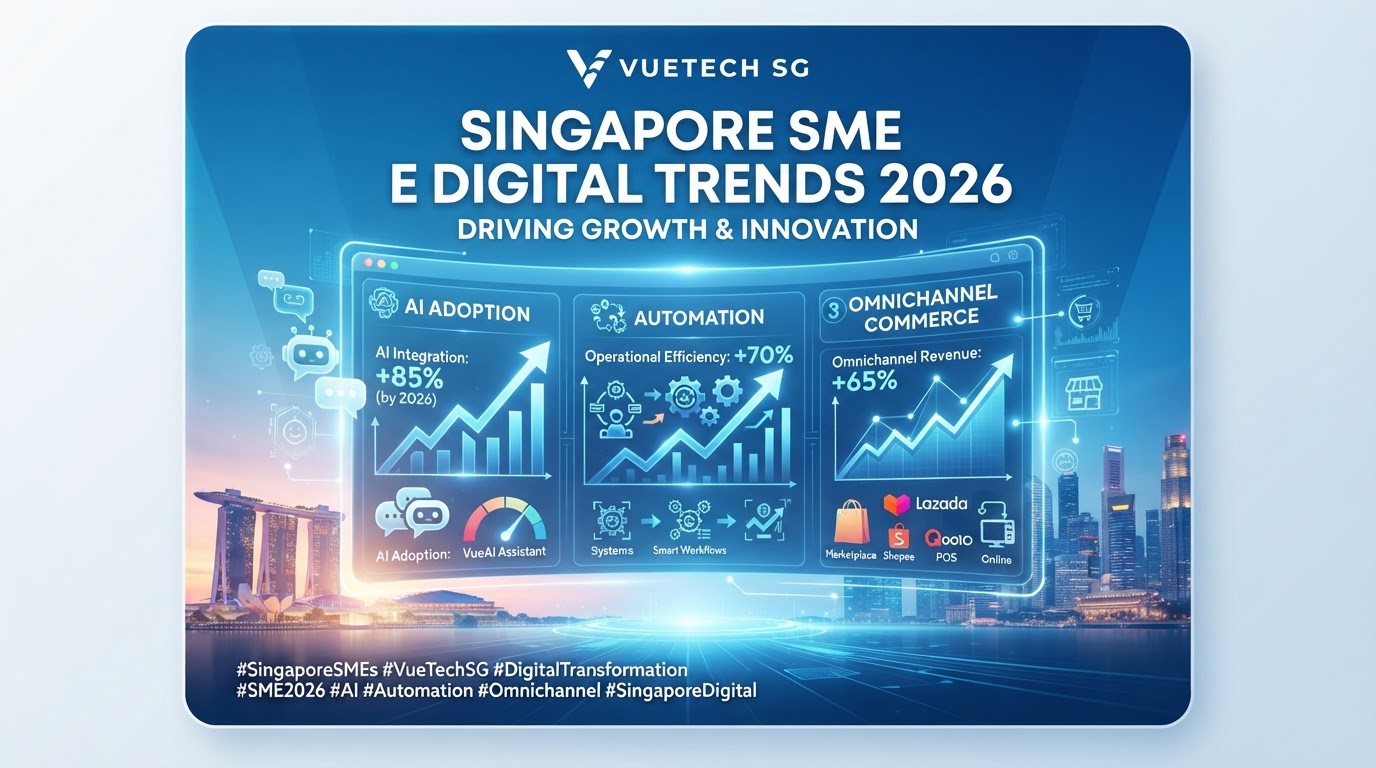
Singapore SMEs are no longer asking whether they should adopt digital technology. The more important question is how to use technology to reduce operating costs, improve customer experience and create sustainable growth.
Artificial intelligence, workflow automation, omnichannel commerce and cybersecurity are becoming essential parts of modern business operations. According to IMDA’s Singapore Digital Economy Report, AI adoption among Singapore SMEs increased from 4.2% in 2023 to 14.5% in 2024.
Here are the most important Singapore SME digital trends in 2026 businesses should understand.
1. AI is moving from experimentation to everyday business operations
Many businesses initially used AI for content writing, brainstorming and basic research. In 2026, the focus is shifting towards practical business applications.
Singapore SMEs are increasingly using AI for:
- Customer service and enquiry handling
- Lead qualification
- Sales follow-ups
- Finance and accounting tasks
- Internal knowledge management
- Marketing content creation
- Data analysis and reporting
IMDA reports that common business functions using AI include information technology, customer service, and finance and accounting.
The most effective approach is not to add AI randomly. Businesses should identify repetitive tasks that consume staff time, then introduce AI where it can improve speed, consistency and response times.
For example, an AI chatbot connected to a CRM system can answer common questions, capture leads and notify the sales team when a customer is ready to buy. A platform such as 1CloudAI CRM can help businesses organise conversations, automate follow-ups and manage customer journeys across multiple channels.
2. AI Chatbot Grant Support for Singapore SMEs
One practical way for Singapore SMEs to begin their AI journey is through a grant-supported AI chatbot solution.
VueTech SG’s AI chatbot can help businesses:
- Answer customer enquiries 24/7
- Capture and qualify sales leads
- Automate follow-ups
- Support bookings and appointments
- Manage conversations across selected channels
- Connect customer interactions with 1CloudAI CRM
The AI chatbot solution is listed in the IMDA SMEs Go Digital solution directory, where grant support is available for eligible solutions.
Businesses should note that grant support is not guaranteed. Eligibility depends on the company, selected activity, solution package and approval requirements. From 30 September 2026, businesses should refer to the EDGE Grant for new applications, following the conclusion of the PSG application period. Read VueTech SG’s AI chatbot and grant guide.
For approved businesses, an AI chatbot can be a cost-effective way to improve response times, reduce repetitive work and capture more opportunities without immediately expanding the customer service team.
Start Your AI Chatbot Project with Grant Support
Capture enquiries, automate replies and manage every customer conversation inside 1CloudAI CRM — a listed solution under the EDGE Grant programme.
3. Workflow automation is becoming more valuable than standalone AI tools
Using several separate AI tools does not automatically create a smarter business. The real value comes from connecting AI to a clear workflow.
A typical automated workflow could look like this:
- A customer submits an enquiry through a website.
- The system records the contact details.
- AI categorises the enquiry.
- The customer receives an immediate response.
- A sales team member is notified.
- Follow-up messages are sent automatically.
- The business tracks the final outcome.
This type of automation reduces missed enquiries and allows small teams to handle more customers without increasing their administrative workload.
Businesses should begin with one clear process rather than attempting to automate everything at once. Good starting points include appointment bookings, lead follow-ups, quotation requests, customer reviews and abandoned enquiries.
4. Omnichannel commerce is becoming an operating model
Customers now discover and purchase products through multiple channels, including websites, marketplaces, social media, messaging apps and physical stores.
Managing each channel separately can create problems such as:
- Inaccurate inventory levels
- Delayed order processing
- Inconsistent product information
- Duplicate customer records
- Difficulty tracking sales performance
Omnichannel commerce connects these channels into one coordinated system. Products, orders, stock levels and customer information can be managed more efficiently across multiple sales platforms.
This is especially important for retailers selling through platforms such as Shopee, Lazada, TikTok Shop and their own eCommerce website.
Businesses can learn more about this approach in our guide to the benefits of omnichannel eCommerce.
5. Websites must be prepared for AI-powered search
A website is no longer only an online brochure. It is also a source of information used by search engines, AI tools and potential customers during their research.
In 2026, businesses should make sure their website has:
- Clear service descriptions
- Helpful answers to common questions
- Proper heading structures
- Fast mobile performance
- Descriptive page titles and meta descriptions
- Strong internal links
- Accurate business information
- Original case studies and customer insights
Businesses should focus on answering real customer questions instead of publishing content purely to insert keywords.
For example, instead of writing a general article about digital marketing, a Singapore business could publish practical content about:
- How much Google Ads costs in Singapore
- How to choose an eCommerce platform
- How AI chatbots support customer service
- How retailers can manage multiple marketplaces
- How SMEs can prepare for AI adoption
A strong SEO strategy combines technical optimisation, useful content and a clear conversion journey. Businesses can also refer to our guide on technical SEO and website performance.
6. Cybersecurity is now part of business growth
As businesses adopt more cloud platforms, payment systems, CRM tools and AI applications, cybersecurity becomes increasingly important.
A security incident can affect more than company data. It can also damage customer trust, interrupt operations and create financial losses.
IMDA reported that more than eight in ten organisations experienced at least one cybersecurity incident annually.
Singapore SMEs should review:
- Website and hosting security
- Staff access permissions
- Password management
- Software updates
- Customer data protection
- Payment gateway security
- Backup procedures
- Phishing awareness
Businesses should also ensure that employees understand how to handle sensitive information when using AI tools. Customer data, passwords and confidential documents should not be copied into public AI systems without proper safeguards.
7. Digital adoption is becoming more practical for retailers
Digital transformation is no longer limited to large companies. Government programmes and industry initiatives are making AI and digital tools more accessible to local SMEs.
Enterprise Singapore reported that nine in ten retail SMEs surveyed in 2025 experienced productivity gains from digital adoption, including reduced operating costs, increased market share or higher revenue.
For retailers, practical improvements may include:
- Digital inventory management
- AI-assisted customer support
- Online ordering
- Integrated payment systems
- Loyalty programmes
- Automated marketing campaigns
- Sales reporting across multiple channels
The right solution depends on the business model, budget, existing systems and operational priorities. Businesses should assess the problem first, then choose the technology.
8. A practical 90-day digital roadmap for SMEs
Days 1–30: Identify the biggest operational problem
Start by documenting repetitive tasks and customer pain points.
Ask:
- Which tasks take the most staff time?
- Where are enquiries being missed?
- Which systems do employees use every day?
- Where are customers experiencing delays?
- Which reports are difficult to prepare?
Days 31–60: Implement one focused solution
Choose one area for improvement, such as:
- Website lead capture
- AI customer support
- CRM follow-up automation
- eCommerce integration
- Inventory management
- SEO content optimisation
The goal is to create a measurable improvement rather than adopt technology for its own sake.
Days 61–90: Measure the results
Track practical business outcomes such as:
- Response time
- Number of qualified leads
- Conversion rate
- Staff hours saved
- Website enquiries
- Repeat purchases
- Customer satisfaction
- Operating cost
If the solution produces positive results, the business can gradually expand automation to other areas.
Final thoughts
The biggest Singapore SME digital trend in 2026 is not simply the rise of AI. It is the move towards connected digital operations.
AI, automation, eCommerce, CRM, SEO and cybersecurity work best when they support the same business goals. SMEs that adopt technology in a focused and measurable way can improve productivity while creating a better experience for customers.
VueTech SG helps Singapore businesses with professional websites, eCommerce development, SEO, SEM, AI chatbots and digital automation solutions. Contact VueTech SG to discuss the right digital strategy for your business.