How to Choose an SEM Agency in Singapore: A Buyer's Scorecard
Short answer: choose an SEM agency (also called a Google Ads or PPC agency) in Singapore that leaves the Google Ads account and its Admin access with your company, tells you its fee in writing before you pay, tracks real enquiries, and reports Google’s exact cost separately from its own fee. Then divide its fee by your ad budget to compare quotes, and judge it on cost per lead after about 90 days.
The usual advice is to check for a Google Partner badge and own your account. This guide adds the rules Google itself sets for agencies, which access level to give whom, the fee maths including GST, and a scorecard you can fill in while you compare proposals.
Key takeaways
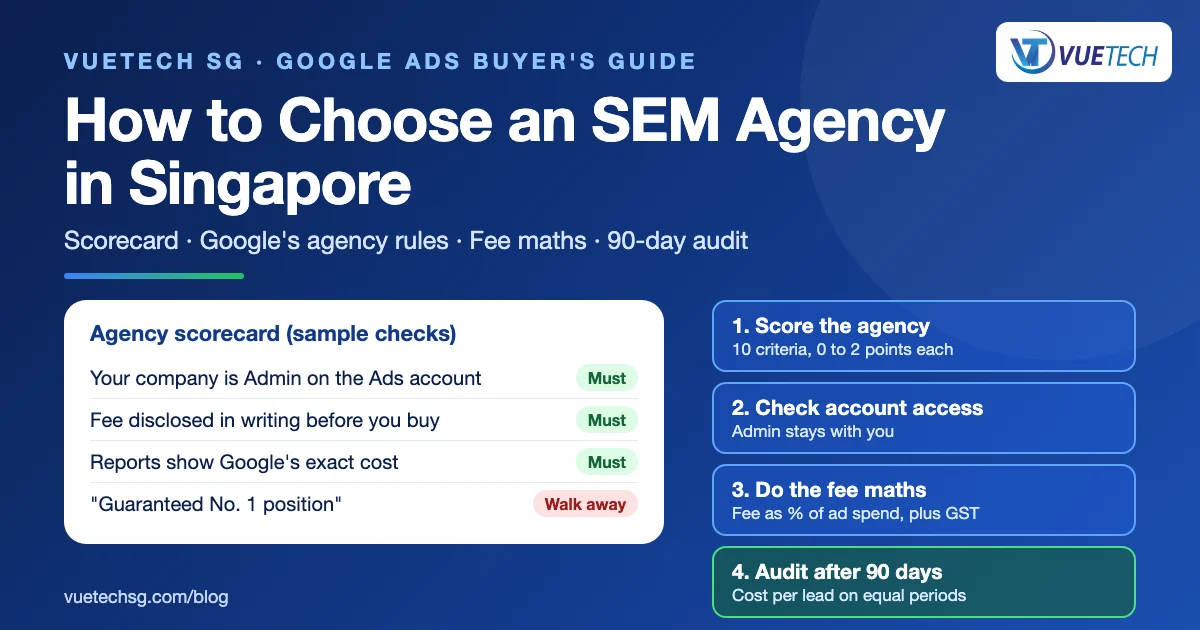
- Score each agency on 10 criteria. Three are deal-breakers: you own the account, the fee is disclosed up front, and no one promises a guaranteed position.
- Google’s own third-party policy says agencies must show you Google’s exact cost, disclose their fee in writing and give you your customer ID on request.
- Keep Admin for two people in your company. The agency needs Standard access to run campaigns.
- A fixed fee is a big share of a small budget; a percentage fee grows as you spend more. Work out the fee as a % of ad spend, then add GST.
- Review after about 90 days: cost per lead on two equal periods, the search terms report and the change history.
What should you look for in an SEM agency?
Look for ten things, and score each one 0 (no), 1 (partly) or 2 (yes, in writing). An agency scoring 16 or more out of 20 is a strong candidate. Between 12 and 15, ask it to fix the gaps in writing before you sign. Below 12, keep looking. Any agency that scores 0 on one of the three must-haves is out, whatever its total.
| Criterion | What good looks like | Question to ask |
|---|---|---|
| You own the accountMust | The Google Ads account is in your company's name and your own staff hold Admin access. | Whose name is the account in, and who are the Admin users? |
| Fee disclosed up frontMust | The management fee is in writing before you pay, shown on every invoice, and kept separate from the ad cost. | Can I see the fee, any setup fee and GST in writing? |
| Honest promisesMust | No guaranteed ad position or ranking. A 90-day plan with the numbers you will review instead. | What exactly will you have done, and measured, by day 90? |
| Conversion tracking plan | Names the actions it will track (forms, calls, WhatsApp clicks, purchases) and tests them before spending. | Which conversion actions will you track, and how do you test them? |
| Useful reporting | A monthly report with Google's exact cost, clicks and impressions, plus leads and cost per lead. | Can I see a sample report with the client's name removed? |
| Search terms and negatives | A set rhythm for reviewing the search terms report and adding negative keywords. | How often do you review search terms, and can I see the change history? |
| Fair contract terms | A clear minimum term and notice period, no exit fee, and a handover of access and assets when you leave. | What happens to my account, ads and audiences if I stop? |
| Who does the work | A named person runs your account, and any Google Partner badge checks out when you click it. | Who will manage my account day to day? |
| Relevant proof | Case studies with real figures, dates and periods, ideally for a similar sales cycle to yours. | What changed, over which dates, and what did a lead cost before and after? |
| Landing page view | Comments on the page your ads will send people to, because landing page experience is part of Quality Score. | What would you change on my landing page before launch? |
The scorecard is our own framework, built from the questions below. Change the weights if one matters more to you, for example relevant proof for a regulated industry.
What does Google require from Google Ads agencies?
Google has a third-party policy for agencies that manage ads for others, and an advertiser guide on working with them. Together they turn several “nice to have” questions into rules you can point to.
| Rule | What it means for you | Google page |
|---|---|---|
| Reports must show Google's cost | If an agency sends monthly reports, they must include costs, clicks and impressions at account level, and the exact amount Google charged, without the agency's fees. It can also let you sign in to the account to see this yourself. | Transparency requirements |
| The management fee must be disclosed | A fee charged on top of Google Ads costs must be given to new customers in writing before the first purchase and shown on all invoices. | Transparency requirements |
| You can have your customer ID | Agencies must give you the customer ID of your Google Ads account when you ask for it. | Transparency requirements |
| You get your own account | Google says the agency must set up a separate Google Ads account for you. | Advertiser guide: working with third parties |
| No one can guarantee a position | Google says it is not possible to guarantee a specific ad position on Google search results, and that advertising has no effect on your organic ranking. | Advertiser guide: working with third parties |
| Small-budget agencies share a notice | If 80% or more of an agency's customers spend less than US$1,000 a month, it must share Google's disclosure notice with customers and link to it on its website. | Transparency requirements |
Google also says only approved companies may show a Partner badge, and that you can check one by clicking it on the agency’s website. A Google Partner needs an optimisation score of at least 70%, US$10,000 of ad spend across its managed accounts over 90 days, and at least half of its account strategists certified. Premier Partners are the top 3% of participating companies in a country, set each year. The badge shows activity and training, not results for a business like yours.
Who should own the Google Ads account, and what access should the agency get?
Your company should own the account and pay Google directly, with two of your own people as Admin. Give the agency Standard access: it can build and edit campaigns, but it cannot add or remove users. Google lists five access levels:
| Access level | What it can do | Give it to |
|---|---|---|
| Admin | Everything, including adding or removing users, changing access levels, accepting manager-account link requests and linking Google Analytics. | Two people in your own company |
| Standard | Edit campaigns, view and edit billing, run reports. Cannot manage user access. | The agency's account manager |
| Read-only | View campaigns and reports. Cannot change anything. | Managers who want to look in |
| Billing | View and edit billing information and payments. Cannot view or edit campaigns. | Your finance team or accountant |
| Email-only | Receive notification emails and reports only. | Anyone who only needs the reports |
Why two Admins? Google warns that if an account has only one administrator, you may lose access to your tags if that person becomes unavailable, for example when a staff member leaves. And because only Admins can remove users, keeping Admin in-house means you can end an agency’s access yourself, on the day you choose.
Fixed fee or percentage of ad spend: what do you really pay?
Turn every quote into one number: the fee as a percentage of the ad budget. A fixed fee is a large share of a small budget and a small share of a big one. A percentage fee stays the same share, so it costs more as you spend more, and it pays the agency more when you spend more. The table compares our fixed fees from our price list with an illustrative fee of 20% of spend.
| Ad spend / month | Fixed fee (package) | Fixed fee as % of spend | Fee at 20% of spend |
|---|---|---|---|
| S$1,000 | S$600 (Bronze) | 60% | S$200 |
| S$2,500 | S$600 (Bronze) | 24% | S$500 |
| S$5,000 | S$1,200 (Silver) | 24% | S$1,000 |
| S$10,000 | S$1,800 (Gold) | 18% | S$2,000 |
| S$20,000 | S$1,800 (Gold) | 9% | S$4,000 |
Two things stand out. At S$1,000 a month, a S$600 fixed fee is 60% of what you spend on clicks, so ask whether a bigger budget, a narrower campaign or running it yourself makes more sense. At the 20% illustration, a percentage fee costs more than our S$1,800 Gold fee once spend passes S$9,000 a month.
Worked example: three months on a S$2,500 budget
Say you spend S$2,500 a month for the 3-month minimum on our Bronze package. Google’s tax help page says Google Ads sales in Singapore have been subject to 9% GST since 1 January 2024 for accounts with a Singapore business address, and our fees exclude GST.
- Ad spend: 3 × S$2,500 = S$7,500, plus 9% GST of S$675
- Management: 3 × S$600 = S$1,800, plus 9% GST of S$162
- Total: S$10,137, of which S$1,962 (about 19%) is management
Do the same sum for each quote, including any setup fee, and you are comparing like with like. GST-registered businesses may be able to claim the GST back; check with your tax adviser. For click prices by keyword and industry, see how much Google Ads and SEM cost in Singapore.
Agency, freelancer or in-house: which fits you?
An agency suits most SMEs that want enquiries without hiring. A freelancer can suit a single, simple campaign. In-house makes sense once ads are a large, steady part of your sales and you can keep someone busy full-time.
| Agency | Freelancer | In-house | |
|---|---|---|---|
| Cover when someone is away | Usually a team | One person | Depends on headcount |
| Cost structure | Monthly fee | Monthly or hourly fee | Salary, CPF, training, tools |
| Range of skills | Often ads plus tracking, design and landing pages | Varies by person | Deep knowledge of your business |
| Main risk | Your account gets less attention than bigger clients | Access and know-how leave with one person | Few outside benchmarks; slow to cover a resignation |
| Best for | SMEs wanting leads without hiring | One simple Search campaign | Large, steady ad budgets across many campaigns |
Whichever you choose, the account ownership and access rules above stay the same.
What should an SEM proposal tell you?
A good proposal answers these ten points without you having to ask. Any point left blank is a question for your next call, and the answer should go into the contract.
- The monthly fee, the ad budget range it covers, and what happens if you spend more.
- Any setup fee, and whether prices include or exclude GST.
- The minimum term, the notice period and any exit fee.
- Whose name the Google Ads account and billing are in, and the access level the agency will have.
- The conversion actions to be tracked, and who installs and tests them.
- The report: how often, which numbers, and whether it shows Google's exact cost.
- What is not included, such as creative design, video or landing page changes.
- Who manages the account day to day, and how fast they reply.
- What will be done in the first 30, 60 and 90 days.
- What you receive if you leave: access removed cleanly, ads, keyword lists and audiences left in your account.
What are the red flags when hiring an SEM agency?
Walk away, or at least slow down, if you see any of these:
- A guaranteed first position, or a promise that ads will lift your organic ranking. Google says neither is possible.
- The agency creates the account under its own name or billing and won't move it to you.
- Reports show a single “total cost” that mixes Google's charges with the agency's fee.
- No conversion tracking, or “conversions” that are really page views or time on site.
- Someone claims to be calling from Google but can't email you from an @google.com address.
- A Partner badge that doesn't open Google's verification page when you click it.
- A long lock-in with an exit fee and no performance review point.
How do you check an SEM agency after 90 days?
Sign in to your own account and look at six things. You don’t need to be an expert: you are checking that work is happening, that conversions are real, and that cost per lead is moving the right way.
| Check | Where in Google Ads | What good looks like |
|---|---|---|
| Change history | Change history in Google Ads | Regular, explained changes, not one burst before each report. |
| Search terms | Search terms report | Irrelevant searches are being added as negative keywords. |
| Conversion actions | Goals > Conversions summary | Primary conversions are real enquiries or sales, not page views. |
| Cost per lead | Campaigns, with conversion columns, on two equal date ranges | Stable or falling, and explained when it rises. |
| Quality Score | Keywords, with Quality Score columns | Low scores on your main keywords have a plan (ad or landing page fixes). |
| Users and access | Admin > Access and security | Your staff are still Admin; no unknown users. |
Compare equal periods, never single days. In our Google Ads case study for 123 LED Lighting we compared two 38-day periods: contacts rose 17% while cost fell 25%, so cost per contact dropped from S$14.46 to S$9.21. The first fix was making sure only real enquiries counted as conversions. Landing page speed matters too, because landing page experience is part of Quality Score; see our website performance optimisation service.
How VueTech SG works with you
We charge a fixed monthly fee by ad budget tier: S$600 for budgets up to S$2,500, S$1,200 up to S$5,000 and S$1,800 with no cap. Prices exclude GST, need a 3-month minimum and include monthly reporting. The ad budget is paid to Google separately, and creative design and landing page work are not included. We work in your own Google Ads account, so the account, its data and its history stay with you. Full details are on our SEM services page, and our SEM services guide explains what the work includes.
FAQ
How much does an SEM agency cost in Singapore?
You pay two things: the ad budget, which goes to Google, and the agency's management fee. Fees are usually a fixed monthly amount or a percentage of ad spend. Ours is a fixed fee by budget tier: S$600 a month for ad budgets up to S$2,500, S$1,200 up to S$5,000 and S$1,800 with no cap, excluding GST, with a 3-month minimum. Divide any quote by your planned ad spend to compare agencies fairly.
Should my company or the agency own the Google Ads account?
Your company. Keep the account and billing in your company's name with your own staff as Admin, and give the agency the access it needs to manage campaigns. Google's advertiser guide says an agency must set up a separate account for you, and its transparency requirements say it must give you your customer ID when you ask.
What access level should I give my SEM agency?
Standard access is enough to build and edit campaigns. Keep Admin for at least two people in your own company: only Admin users can add or remove users and change access levels, and Google warns that an account with a single administrator can lose access to its tags if that person becomes unavailable.
Is a Google Partner agency always better?
It is a useful filter, not a guarantee. Google Partners need an optimisation score of at least 70%, US$10,000 of ad spend across managed accounts over 90 days, and at least half of their account strategists certified. Premier Partners are the top 3% of participating companies in a country, set each year. None of this measures results for a business like yours.
Can an SEM agency guarantee the first position on Google?
No. Google says it is not possible to guarantee a specific ad position on its search results. Treat a guaranteed position, or a promise that ads will improve your organic ranking, as a reason to walk away.
Do I pay GST on Google Ads in Singapore?
Google's tax help page says that from 1 January 2024 Google Ads sales in Singapore are subject to 9% GST for accounts with a Singapore business address. An agency that is GST-registered also adds GST to its fee. Check both on your invoices, and ask your tax adviser about claiming it back.
When should I judge whether my SEM agency is working?
Give it about 90 days. In the accounts we manage, the first weeks go on tracking, keyword cleanup and letting automated bidding learn. Then compare cost per lead over two equal periods, not single days. In our 123 LED Lighting case study we compared two 38-day periods: contacts rose 17% while cost fell 25%.
Get a second opinion on your Google Ads
Comparing proposals, or unsure about your current agency? Send us your website and what you sell. We’ll tell you what we would check first and which package fits your budget.
Sources
- Google Advertising Policies Help: Transparency requirements (third-party policy)
- Google Advertising Policies Help: Advertiser guide, working with third parties
- Google Ads Help: About access levels in your Google Ads account
- Google Ads Help: How to become a Google Partner or Premier Partner
- Google Ads Help: Taxes in your country (GST in Singapore)
- Google Ads Help: About Quality Score for Search campaigns
- VueTech SG SEM packages (/promo-price), checked November 23, 2026
Published November 23, 2026. Google pages read on November 23, 2026. Google may change its policies; check the linked pages for the current wording.